Introduction: A New Era in AI Computing
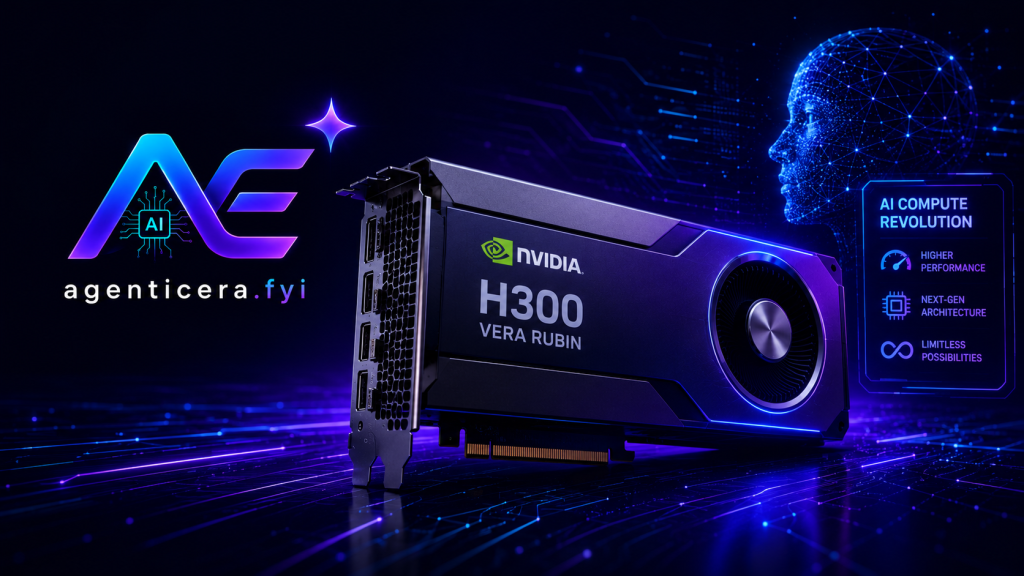
The artificial intelligence landscape is evolving at an unprecedented pace, and at the center of its next chapter sits the NVIDIA H300 GPU, the flagship accelerator of NVIDIA’s Vera Rubin platform. Announced at CES 2026, the H300 isn’t just another incremental upgrade — it represents a generational leap in what’s possible with AI hardware.
From training trillion-parameter models to slashing inference costs, the H300 is designed to make the next wave of AI breakthroughs faster, cheaper, and more accessible than ever before.
What Is the NVIDIA H300? Understanding the Vera Rubin Platform
The NVIDIA H300 is the GPU at the heart of NVIDIA’s Vera Rubin architecture — a full-stack, rack-scale AI computing platform named after astronomer Vera Rubin, who discovered evidence of dark matter in the universe.
Vera Rubin isn’t a single chip — it’s an integrated ecosystem of seven co-designed components:
- Rubin GPU (H300)
- Vera CPU
- ConnectX-9 NIC
- BlueField-4 DPU
- Spectrum-X 102.4T Ethernet
- NVLink 6 interconnect
- HBM4 high-bandwidth memory
This tightly integrated system eliminates bandwidth bottlenecks that have historically limited large-scale AI workloads. Think of it as a complete AI supercomputer architecture, not just a GPU upgrade.
NVIDIA H300 Key Specifications
| Specification | H300 (Rubin GPU) |
|---|---|
| Architecture | Vera Rubin (TSMC 3nm) |
| AI Performance | 50 petaFLOPS FP4 |
| Memory | 288 GB HBM4 |
| Memory Bandwidth | 22 TB/s |
| Interconnect | NVLink 6 |
| Platform | Rubin NVL144 rack |
| Rack-Level Performance | 3.6+ ExaFLOPS dense FP4 |
| Availability | H2 2026 (partner systems) |
H300 vs. Previous Generations: A Quantum Leap Forward
To understand why the H300 matters, it helps to compare it to what came before.
H300 vs. Blackwell (B200/B300): The H300 delivers approximately 5x the inference performance of NVIDIA’s Blackwell generation. It can train massive Mixture-of-Experts (MoE) models using just one-quarter the number of GPUs, at roughly one-seventh the token cost.
H300 vs. Hopper (H100/H200): The jump is even more dramatic when compared to the Hopper generation. The H100 carried 80 GB of HBM3 memory; the H300 carries 288 GB of HBM4 with nearly three times the bandwidth.
This isn’t evolution — it’s a revolution in what enterprises can do with AI at scale.
How the H300 Will Shape the Future of AI
1. Making Trillion-Parameter Models Practical
Today, training frontier AI models with hundreds of billions or trillions of parameters requires enormous clusters of GPUs, vast amounts of energy, and significant capital. The H300 changes this equation dramatically.
With 50 petaFLOPS of FP4 compute per GPU and the ability to scale to 3.6 ExaFLOPS across a single Rubin NVL144 rack, enterprises and research institutions can run workloads that previously required entire data center floors — on a fraction of the hardware. This democratizes cutting-edge AI research and brings trillion-parameter model training from the realm of Big Tech into reach for a broader set of organizations.
2. Transforming Enterprise AI Deployment
Jensen Huang, NVIDIA’s CEO, has described computing demand as “off the charts,” projecting at least $1 trillion in revenue for NVIDIA between 2025 and 2027. The H300 is central to that vision.
By dramatically reducing the GPU count needed for equivalent training runs, the H300 lowers the total cost of ownership (TCO) for AI infrastructure. For enterprises building AI factories — from healthcare to financial services to logistics — this translates into faster ROI on AI investments.
3. Supercharging AI Inference
One of the most important shifts in AI today is the move from training to inference — actually deploying AI models in real-world products and services. Jensen Huang has described NVIDIA as the “inference king,” and the H300 reinforces that claim.
The H300’s adaptive precision capabilities and NVFP4 support mean it can serve AI responses faster and at lower cost per token than any previous generation. For applications like AI assistants, real-time translation, drug discovery pipelines, and autonomous systems, this is a game-changer.
4. Enabling Agentic AI at Scale
The Vera Rubin platform was specifically designed with the next generation of agentic AI in mind — AI systems that can reason, plan, and act autonomously across complex tasks. By unifying chips, networking, and software into a coherent architecture, NVIDIA enables organizations to build AI agents that can scale from a desktop workstation to a multi-rack AI factory without re-engineering their stack.
The Competitive Landscape: Can Anyone Catch NVIDIA?
While the H300 cements NVIDIA’s position at the top of the AI hardware market, competition is intensifying. AI chip startups attracted $8.3 billion in global funding in 2026, according to Dealroom, with challengers including:
- AMD MI350/MI400 series — targeting competitive performance for memory-bound workloads
- Google TPU v7 (Ironwood) — claiming 100% better performance per watt than previous TPUs
- Custom ASICs from Amazon (Trainium), Microsoft, and OpenAI — projected to grow 44.6% in 2026 vs. 16.1% for GPU shipments
- Startups like Cerebras, Etched, MatX, and SambaNova targeting specific inference workloads
Despite these challengers, NVIDIA holds an estimated 80–92% market share in AI accelerators and continues to invest over $18 billion annually in R&D. The H300’s performance advantage, combined with NVIDIA’s software ecosystem (CUDA, NeMo, TensorRT), remains a formidable moat.
Supply Chain and Availability: What to Expect
The H300 uses HBM4 memory, the next generation of high-bandwidth memory that is both more powerful and more constrained than HBM3E. SK Hynix has reportedly secured approximately 70% of NVIDIA’s HBM4 orders for the Vera Rubin platform, with Micron and Samsung supplying the rest.
- Partner systems: Available H2 2026
- Full Rubin Ultra NVL576 platform: Expected 2027
- Chips are already in validation with real-world trillion-parameter workloads
Organizations planning AI infrastructure investments in 2026–2027 should factor Vera Rubin timelines into their roadmaps carefully.
NVIDIA’s Roadmap: H300 and Beyond
The H300 is not NVIDIA’s final word. According to NVIDIA’s publicly confirmed roadmap:
| Generation | Platform | Timeline |
|---|---|---|
| Blackwell Ultra | B300 / GB300 NVL72 | H2 2025 |
| Vera Rubin | H300 / Rubin NVL144 | H2 2026 |
| Rubin Ultra | NVL576 | 2027 |
| Feynman | Next-gen HBM | 2028 |
Each generation is expected to carry a 20–30% pricing premium at launch relative to its predecessor, reflecting the exponentially growing performance it delivers.
Who Will Benefit Most from the NVIDIA H300?
The H300 is poised to have the biggest impact across several key industries:
- Healthcare & Life Sciences — Accelerating drug discovery, genomics, and medical imaging AI
- Financial Services — Powering real-time risk modeling, fraud detection, and algorithmic trading
- Autonomous Vehicles — Training next-generation perception and decision-making models
- Cloud Providers — Reducing cost-per-token for AI services at hyperscale
- Research Institutions — Opening frontier AI research to organizations without billion-dollar budgets
Conclusion: The H300 Is More Than a GPU — It’s a Turning Point
The NVIDIA H300, as the flagship of the Vera Rubin platform, represents one of the most significant milestones in the history of AI hardware. With 5x the inference performance of Blackwell, 288 GB of HBM4 memory, and a tightly integrated rack-scale architecture, it brings trillion-parameter AI from a distant ambition to near-term enterprise reality.
As AI shifts from experimentation to production deployment, the infrastructure powering those systems matters enormously. The H300 doesn’t just upgrade what’s possible — it redefines the baseline for what serious AI infrastructure looks like in 2026 and beyond.
For enterprises, researchers, and cloud providers planning their next move, the message is clear: the era of Vera Rubin is about to begin.
Last updated: May 2026 | Keywords: NVIDIA H300, Vera Rubin GPU, AI accelerator 2026, H300 specs, NVIDIA AI chip, future of AI hardware, trillion-parameter AI, H300 vs Blackwell