Direct Answer Summary: Anthropic released Claude Opus 4.8 on May 28, 2026 — a major upgrade to its flagship AI model that improves agentic coding, multidisciplinary reasoning, and honesty, all at the same price as its predecessor. The model launches alongside two significant new features: dynamic workflows in Claude Code and user-facing effort control. It is available today for all Pro, Max, Team, Enterprise, and API users.
Introduction: A Surprise Release, Only 41 Days Later
Just six weeks after shipping Claude Opus 4.7, Anthropic has released Claude Opus 4.8 — its most capable publicly available AI model to date. The release, announced on May 28, 2026, arrives faster than any previous Opus upgrade, a timeline that signals both accelerating competition in frontier AI and, some observers note, a quiet acknowledgment that Opus 4.7 underwhelmed a portion of its user base.
So, is this a big deal? Yes — with a few important caveats. Opus 4.8 delivers real, measurable improvements in coding performance, agent reliability, and honesty, and it ships with two genuinely useful new features. But it does not yet reach the level of Anthropic’s most advanced internal model, Claude Mythos — a system that remains in limited testing with select organizations.
Here is everything you need to know.
What Is Claude Opus 4.8 and What’s New?
Claude Opus 4.8 is the newest version of Anthropic’s most powerful publicly available AI model. Anthropic describes it as a “more effective collaborator” with upgrades across agentic coding, multidisciplinary reasoning, agentic computer use, professional knowledge work, and financial analysis.
The headline improvements break down into three areas:
1. Better performance on key benchmarks
| Benchmark | Opus 4.7 | Opus 4.8 |
|---|---|---|
| SWE-Bench Pro (agentic coding) | 64.3% | 69.2% |
| Multidisciplinary reasoning w/ tools | 54.7% | 57.9% |
| Online-Mind2Web (computer use/browser agent) | Not specified | 84% |
| Fast mode speed | Baseline | 2.5× |
| Fast mode cost vs. prior fast mode | Baseline | 3× cheaper |
On SWE-Bench Pro, Opus 4.8 scores 69.2%, outperforming GPT-5.5 and Gemini 3.1 Pro on that specific test. GPT-5.5 still leads on terminal-coding benchmarks, so neither model dominates across every measure.
2. A meaningful honesty upgrade
One of the most significant — and least flashy — improvements in Opus 4.8 is honesty. Anthropic’s evaluations show that Opus 4.8 is approximately four times less likely than Opus 4.7 to allow flaws in its own code to pass without flagging them. Early testers report that the model is more willing to flag uncertainty and less likely to claim false progress on a task. Anthropic’s alignment team also found that Opus 4.8 shows lower rates of misaligned behavior — such as deception or cooperation with misuse — and is now comparable to Claude Mythos Preview on those measures.
3. Two new platform features shipping today
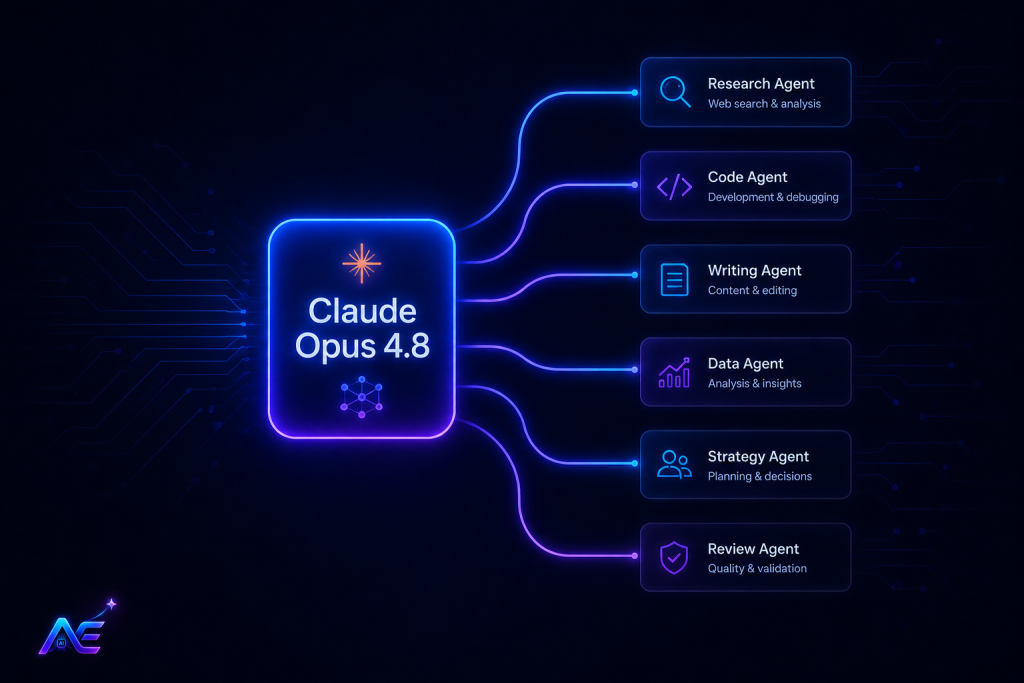
- Dynamic Workflows (research preview): Available in Claude Code for Enterprise, Team, and Max users, this feature allows Claude to orchestrate hundreds of parallel subagents within a single session. The workflow is written as a JavaScript script by Claude itself and runs in the background — keeping your session responsive while agents execute large tasks like codebase-scale migrations across hundreds of thousands of lines of code. Dynamic workflows are capped at 1,000 subagents.
- Effort Control: Users on claude.ai and Cowork can now choose how much thinking Claude puts into a response. Higher effort settings trigger more frequent, deeper reasoning. Lower settings produce faster replies and conserve rate limits. Opus 4.8 defaults to “high” effort, which Anthropic says strikes the best balance of quality and user experience. Extra (“xhigh” in Claude Code) and max settings are available for the most demanding tasks.
A smaller but developer-relevant update: the Messages API now accepts system-level instructions inside the messages array itself, allowing developers to update Claude’s instructions mid-task without resetting the conversation.
How Does Opus 4.8 Compare to Its Predecessor?
Opus 4.8 is a meaningful step up from 4.7 in practical ways. Early enterprise testers — including engineers at Cursor, Devin, Hebbia, Databricks, and legal AI firm CoCounsel — uniformly report better judgment, fewer tool-calling errors, improved context retention across long sessions, and stronger citation precision in document-heavy workflows. Devin’s CEO Scott Wu noted that Opus 4.8 “fixes the comment-verbosity and tool-calling issues we saw with Opus 4.7.” Cursor’s CEO Michael Truell confirmed Opus 4.8 “exceeds prior Opus models across every effort level” on CursorBench.
Not everything has changed, however. Pricing remains identical: $5 per million input tokens and $25 per million output tokens for standard use, with up to 90% cost savings with prompt caching and 50% with batch processing. Fast mode is priced at $10/$50 per million input/output tokens but is now significantly cheaper relative to the performance it delivers.
Why Does This Matter for Users, Developers, and Businesses?
What does this mean for users? In short: if you do anything with long, autonomous AI tasks — code reviews, legal analysis, financial document review, deep research, or complex data migrations — Opus 4.8 is a material upgrade that arrives without a price increase.
For developers, the dynamic workflows feature is the most structurally important change. The ability to run hundreds of parallel subagents within a single Claude Code session — executing independently, verifying their own outputs, and reporting back only when done — changes the economics of AI-assisted engineering. Tasks that previously required manual orchestration or multiple API sessions can now be handed off in a single prompt.
For the broader AI landscape, the honesty improvements deserve attention that is easy to underestimate. As AI models are trusted with longer-running tasks with less human supervision, the tendency to silently cover up errors rather than flag them is a real safety and reliability problem. Anthropic’s benchmark showing a four-fold reduction in unremarked code flaws is one of the more practically meaningful safety improvements in a model update in recent memory.
What Are the Limitations and Risks?
Should you care about the downsides? Absolutely — a few are worth naming clearly.
- Opus 4.8 is not Mythos. Anthropic’s most advanced model, Claude Mythos, remains in limited availability. Anthropic has said Mythos-class models are expected for all customers “in the coming weeks,” but no firm date has been confirmed.
- Dynamic workflows are a research preview. The feature is not production-ready in the traditional sense. Anthropic itself advises users to “start scoped, watch usage, and verify outputs before trusting long runs.”
- Fast mode has limits. While 2.5× speed and a 3× cost reduction in fast mode are impressive, fast mode still trades some reasoning depth for speed. It is not appropriate for all use cases.
- Benchmarks have context. SWE-Bench Pro and similar tests are standardized, but real-world performance varies by task, domain, and use case. GPT-5.5 still leads on terminal-coding tasks, and individual results will differ.
What Happens Next?
Anthropic has telegraphed two things coming soon:
- Mythos-class models for all customers. Claude Mythos — Anthropic’s most capable and best-aligned model, currently in limited testing with select organizations for high-stakes work including cybersecurity — is expected to reach general availability within weeks. This would represent a significant step up in capability from even Opus 4.8.
- Lower-cost models at Opus 4.8 capability levels. Anthropic has stated it is actively developing models that offer comparable capabilities to Opus 4.8 at a lower price point, expanding access for developers and smaller businesses.
The 41-day gap between Opus 4.7 and Opus 4.8 also suggests Anthropic is accelerating its release cadence — likely in response to competitive pressure from OpenAI’s GPT-5.5 and Google’s Gemini 3.1. How that pace is sustained without compromising safety evaluations will be worth watching.
FAQ
Q: What is Claude Opus 4.8? Claude Opus 4.8 is Anthropic’s latest flagship AI model, released on May 28, 2026. It improves on Opus 4.7 with better coding performance, reasoning, honesty, and new features including dynamic workflows and effort control.
Q: When was Claude Opus 4.8 released? Anthropic released Claude Opus 4.8 on May 28, 2026 — 41 days after Opus 4.7, making it the fastest major Opus update to date.
Q: How much does Claude Opus 4.8 cost? Pricing is unchanged from Opus 4.7: $5 per million input tokens and $25 per million output tokens. Fast mode is $10/$50 per million input/output tokens. Prompt caching offers up to 90% savings, and batch processing offers 50% savings.
Q: Who has access to Claude Opus 4.8? Opus 4.8 is available today for all claude.ai Pro, Max, Team, and Enterprise subscribers, and via the Anthropic API using the model string claude-opus-4-8. It is also available on AWS, Google Cloud, and Microsoft Foundry.
Q: What are dynamic workflows in Claude Code? Dynamic workflows (research preview) allow Claude to plan a large task, then autonomously run up to 1,000 parallel subagents in a single Claude Code session. The plan executes as a JavaScript script in the background, enabling things like codebase-scale migrations across hundreds of thousands of lines of code.
Q: Is Claude Opus 4.8 better than GPT-5.5? On several benchmarks — including SWE-Bench Pro agentic coding (69.2%) and Online-Mind2Web computer use (84%) — Opus 4.8 outperforms GPT-5.5. However, GPT-5.5 still leads on terminal-coding benchmarks. Which model is “better” depends on your specific use case.
Q: What is effort control in Claude Opus 4.8? Effort control lets users on claude.ai and Cowork choose how much reasoning Claude applies to a response. Higher effort means deeper thinking; lower effort means faster replies that use fewer rate limits. Opus 4.8 defaults to “high” effort.
Q: What is Claude Mythos, and how does it relate to Opus 4.8? Claude Mythos is Anthropic’s most advanced model, currently in limited availability with select organizations. Opus 4.8 is below Mythos in capability but now matches it in alignment and misaligned-behavior rates. Anthropic expects Mythos-class models to be available to all customers within weeks.
Final Takeaway
Claude Opus 4.8 is a genuine, well-grounded upgrade — not a marketing rename. The coding improvements are measurable, the honesty gains are practically meaningful, and dynamic workflows open a new door for autonomous AI engineering at scale. The fact that it arrives at the same price as Opus 4.7 makes it an easy recommendation for anyone already using the model.
The bigger story, however, is what comes next. With Mythos-class models expected in weeks and a faster release cadence now apparent, Anthropic appears to be entering a more aggressive phase of its product roadmap. For developers, businesses, and professionals who rely on frontier AI, the pace of change just got faster.