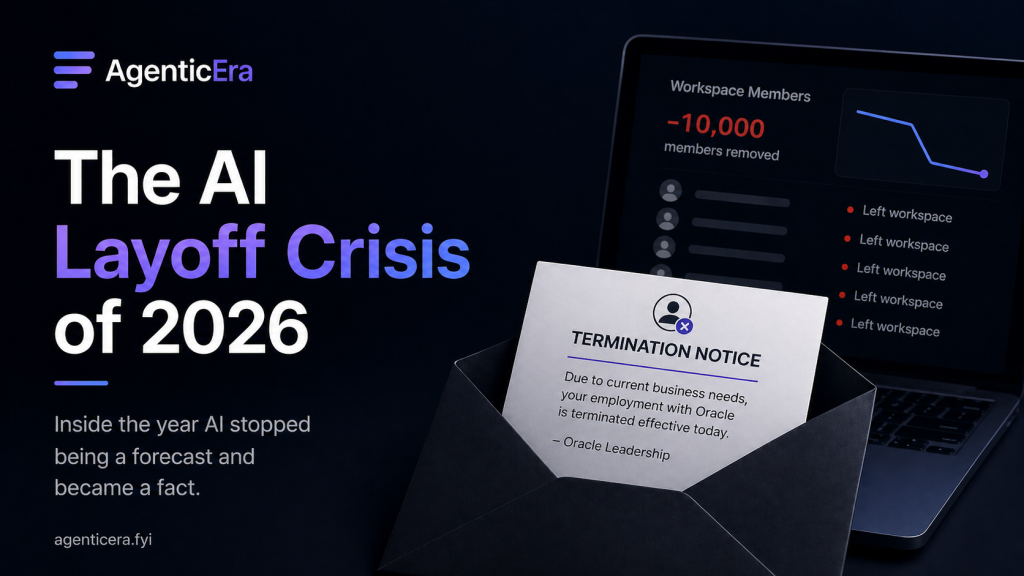
On the morning of March 31, 2026, thousands of Oracle employees across the U.S., Canada, and Europe opened their inboxes to find a termination notice. It was signed simply, “Oracle Leadership.” No meeting. No warning call. Just a brief email citing “current business needs” — and a Slack workspace that quietly shrank by 10,000 users in a single day.
It was perhaps the starkest image yet of what 2026 has become: the year the AI labor crisis stopped being a forecast and became a fact.
The Scoreboard, Four Months In
The numbers are hard to sit with.
Since January 1, over 92,000 tech workers have been laid off across North America, according to Layoffs.fyi. Nearly 80,000 of those cuts happened in the first quarter alone — one of the worst starts to a year the tech industry has ever seen. More than three-quarters of the affected workers are in the United States.
What’s different about 2026 isn’t just the scale. It’s the candor. Almost half of all Q1 cuts — around 37,600 positions — have been directly attributed to AI automation and workflow changes. Companies aren’t hiding it anymore. They’re putting it in the memo.
“This represents a fundamental structural shift rather than a temporary market correction,” said Anthony Tuggle, an executive coach who works with displaced tech workers. He’s not wrong.
The Companies Doing the Cutting
The list of names reads like a roll call of the most powerful companies on earth.
Oracle delivered the single biggest layoff event of the year on March 31, cutting an estimated 20,000 to 30,000 employees in one swift move. TD Cowen analysts had noted months earlier that eliminating that many jobs could generate up to $10 billion in savings — money being redirected to AI data centers, where Oracle faces a $20 billion funding shortfall this year. The company’s stock had already fallen 25% since January. The layoffs were, in the bluntest sense, a financial trade: people for servers.
Amazon eliminated 16,000 corporate roles in January — the second-largest contributor to 2026 tech layoffs. In its own announcement on January 28, the company stated: “The reductions we are making today will impact approximately 16,000 roles across Amazon, and we’re again working hard to support everyone whose role is impacted.” Rolling cuts have continued throughout the year. (Source: CNN Business)
Meta announced in late April that it would cut 10% of its workforce, or about 8,000 employees, with terminations beginning May 20. The language in the internal memo, written by Chief People Officer Janelle Gale and reported by Bloomberg and NPR, was telling: the cuts were designed “to offset the other investments we’re making.” Those investments — between $115 billion and $135 billion in AI capital expenditure this year alone — are almost double what Meta spent in 2025. Hours before the memo leaked, the company had quietly awarded its six most senior executives stock options worth up to $921 million each. The math is uncomfortable: the company is not cutting because it is struggling. It is cutting because it has decided machines are a better use of the money.
Microsoft moved in a different direction — for now. Rather than straight layoffs, the company announced voluntary buyouts for about 7% of its U.S. workforce, roughly 8,750 people. Eligible employees must have a combined age and years of service totaling at least 70. It’s the first time in the company’s 51-year history it has offered this kind of program. Al Jazeera confirmed the buyouts are structured to deliver the same kind of savings as the more aggressive cuts at peers — money flowing toward AI infrastructure.
Dell Technologies cut 11,000 employees — about 10% of its global workforce. Block axed 4,000 jobs, nearly 40% of its headcount. Atlassian reduced its workforce by 10%, about 1,600 people, with CEO Mike Cannon-Brookes specifically calling out the “AI era” as the reason. Nike announced 1,400 cuts concentrated in its technology division. Dow eliminated 4,500 positions as it shifted strategy toward AI-driven processes. Snap cut 1,000 jobs, 16% of its workforce. (Full company-by-company breakdown: Programs.com)
At the current pace, analysts project North America could see over 264,000 tech layoffs by year’s end.
The Pattern No One Can Ignore Anymore
There’s a phrase circulating among workforce analysts right now: the AI employment paradox. It describes something that would have seemed absurd a few years ago — companies simultaneously cutting tens of thousands of workers while spending hundreds of billions of dollars on technology.
Amazon, Google, Meta, and Microsoft alone are expected to spend $650 billion combined on capital expenditures this year, the vast majority of it on AI infrastructure. The salaries of everyone being let go are a rounding error by comparison. As one analyst put it bluntly: the cuts aren’t funding the AI buildout. They’re a signal that the AI buildout has made the current workforce configuration obsolete — at least in the eyes of management.
And it’s not just tech. A 2026 Motion Recruitment study found AI adoption is already slowing hiring for entry-level and “generalized IT roles” across industries. Tech job postings requiring AI skills have grown 67% year-over-year, while postings for traditional software engineering roles have fallen 23%. The market is splitting, and the bottom half is shrinking fast.
“AI Washing” — Real, But Only Part of the Story
Not everyone accepts the AI narrative uncritically, and they raise fair points.
Cognizant’s Chief AI Officer, Babak Hodjat, told Nikkei Asia that AI is sometimes used as “the scapegoat from a financial perspective — when a company hired too many, or they want to resize, and it gets blamed on AI.” OpenAI’s own CEO Sam Altman acknowledged at a summit in India that “there’s some AI washing where people are blaming AI for layoffs that they would otherwise do.” (Reported by Tom’s Hardware)
They’re right. Some of this is companies cleaning up pandemic-era overhiring and dressing it in AI language because it plays better with investors. When Meta announces layoffs, its stock eventually goes up. When Oracle cuts 25,000 jobs, analysts cheer the efficiency.
But here’s the thing: even the skeptics aren’t saying AI won’t eventually cause the displacement it’s currently being blamed for. Hodjat himself said real AI-driven productivity gains — and the layoffs that follow — are still six months to a year away. The AI washing of today is, in a sense, a preview of the genuine disruption coming tomorrow.
The Human Reality
Behind the earnings calls and analyst notes are real people facing a job market that has fundamentally shifted under their feet.
Glassdoor’s Employee Confidence Index showed the tech sector suffered the largest year-over-year confidence drop of any industry in March 2026, falling 6.8 percentage points to 47.2%. Workers aren’t quitting — they’re too scared of what’s outside. And that fear creates a vicious cycle: when natural attrition slows, companies become more aggressive about pushing people out, because they can’t rely on people leaving quietly anymore.
The workers being hit hardest aren’t necessarily underperformers. Meta’s own memo acknowledged as much — the April 2026 cuts weren’t about performance; they were about people being in “the wrong part of the company.” When the company’s Applied AI division expands while other divisions shrink, that’s not a performance story. It’s a structural one.
Meanwhile, outplacement data from early April shows that workers laid off in January are still actively searching at higher rates than in previous cycles. The roles they held — customer support, content, quality assurance — are precisely the ones where AI replacement has moved fastest.
A survey of 1,000 U.S. hiring managers by Resume.org found that 55% expect layoffs at their own companies in 2026, and 44% identified AI as the primary driver. Separately, 57% of Americans say AI is advancing too fast, and 79% are concerned there’s no government plan to protect workers. So far, there isn’t one.
The Outliers — and What They Suggest
Not every company is slashing its way through 2026.
IBM has tripled its entry-level hiring this year, taking the position that while AI can perform many routine tasks, it still needs human oversight and judgment. It’s a bet that companies treating AI as an augmentation tool — rather than a replacement — will build more durable organizations.
Atlassian, notably, said that employees with “transferable skills” were spared in its 10% reduction. It’s a small signal, but a meaningful one — the companies cutting thoughtfully are building bridges for some workers to cross over to the AI era rather than simply eliminating them.
These examples don’t make the overall picture less alarming. But they do suggest the current wave of layoffs isn’t inevitable. It’s a choice.
What Comes Next
The third wave of tech layoffs is now underway — and unlike the pandemic correction of 2022 or the restructuring of 2024, this one no longer needs a cover story. Companies are stating the connection to AI explicitly.
Anthropic’s CEO Dario Amodei and Ford’s Jim Farley have both warned that AI could eliminate up to half of all entry-level white-collar jobs in the U.S. A Stanford study has already found early-stage impact on entry-level coding and customer service roles. An MIT simulation suggests AI could replace nearly 12% of the U.S. workforce, representing around $1.2 trillion in annual salaries.
The World Economic Forum’s Future of Jobs Report 2025 projects that by 2030, 92 million jobs will be displaced globally while 170 million new roles emerge — a net gain on paper. But that paper gain offers cold comfort to a 38-year-old software tester in Ohio or a customer support specialist in Toronto who got the scripted phone call this morning and has six months of runway to figure out what’s next.
The jobs of the future are real. The gap between here and there is also real. And right now, in 2026, most of the people falling into that gap are doing so without a net.
The Bottom Line
What’s happening in 2026 is not a blip, not a correction, and not a story about bad luck or a weak economy. It’s a deliberate reallocation of resources — from people to machines — driven by companies that are profitable, well-funded, and betting heavily that the machines will pay off.
Whether they’re right is almost beside the point for the hundreds of thousands of workers navigating this right now. For them, the AI era isn’t a future possibility. It arrived in their inbox on a Tuesday morning, signed by “Leadership,” with no questions permitted.
The technology is moving faster than the policies meant to manage it, faster than the retraining programs meant to catch people, and faster than the cultural conversation about what we actually owe each other in an economy being remade from the top down.
That’s the story of 2026, four months in. And the year is far from over.
Sources & Verified Links
| Company / Topic | Source |
|---|---|
| Meta 8,000 layoffs | CNBC · Bloomberg · NPR · Al Jazeera |
| Microsoft voluntary buyouts | CNBC · Microsoft Investor Relations |
| Oracle layoffs | CNBC |
| Amazon 16,000 layoffs | CNN Business |
| Meta + Microsoft AI crisis overview | CNBC |
| Q1 2026 tech layoff totals | Tom’s Hardware · TechSpot |
| Company-by-company AI layoff tracker | Programs.com · Layoffs.fyi |
| WEF Future of Jobs | World Economic Forum |
| Worker confidence data | Glassdoor Research |