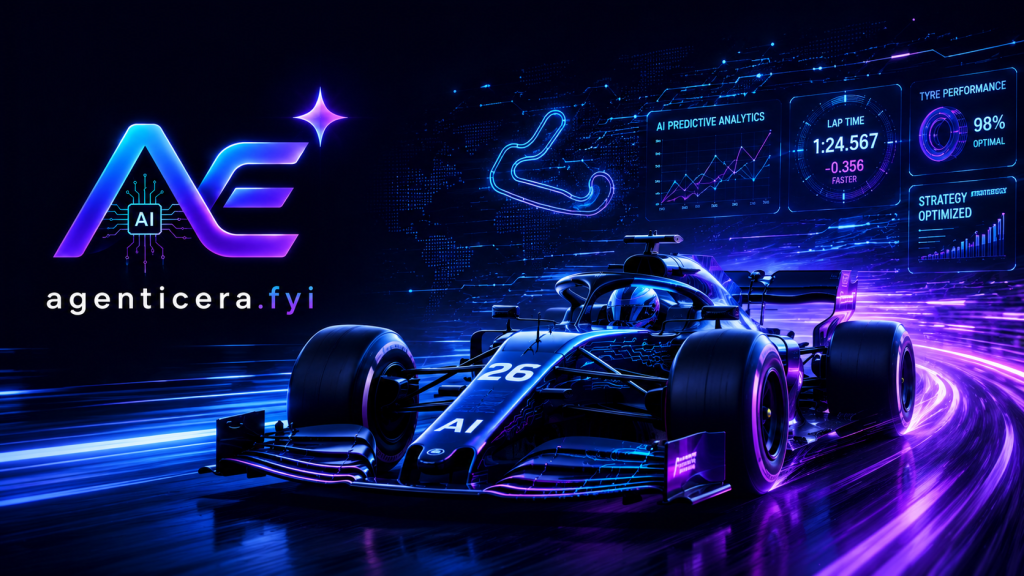
Formula 1 has always been a sport defined by cutting-edge technology — but in 2026, AI is reshaping the sport from the ground up. From race strategy to car design, here’s everything you need to know.
What Is F1’s Relationship With AI?
Formula 1 has never been a stranger to data. Every race weekend generates enormous volumes of information — tire degradation, fuel consumption, track conditions, and competitor behavior. But processing that data fast enough to act on it has always been the challenge. That’s where artificial intelligence comes in.
In 2026, AI is no longer a buzzword or a sponsor’s logo on a rear wing. It is a core part of how F1 teams design cars, make pit-stop decisions, simulate race scenarios, and even manage factory operations. The integration is happening at every level of the sport, and the pace of adoption is accelerating fast.
The Numbers Behind F1’s AI Revolution
The scale of AI’s role in Formula 1 is staggering:
- 8 new AI partnerships were signed across F1 and its 11 teams in just the past six months alone.
- $769 million+ in F1 sponsorship from technology entities last season — a 41% year-over-year increase.
- 1 million+ data points per second will be streamed by 2026 cars across aerodynamic, mechanical, electrical, thermal, and driver inputs.
These figures make one thing clear: AI in F1 is not a trend. It’s a necessity.
How AI Is Being Used in Formula 1
1. Car Design and Simulation
The 2026 technical regulations represent the most sweeping changes to F1 cars in over a decade. Teams must build shorter, narrower, lighter cars — up to 30 kg lighter — featuring active aerodynamics, a near 50/50 split between combustion and electric power, and advanced sustainable fuels.
Redesigning an F1 car from scratch under these constraints is an enormous engineering challenge. AI allows teams to simulate thousands of design configurations in the time it would previously take to test just a handful, dramatically compressing development cycles and helping engineers find performance gains faster.
2. Race Strategy and Pit Wall Decisions
Race strategy has traditionally relied on experienced engineers making high-pressure calls based on intuition and incomplete data. AI is transforming this process. By continuously analyzing tire wear curves, fuel loads, safety car probabilities, and competitor strategies in real time, AI systems help strategists make faster, more confident decisions during a race.
The key shift is not that AI is making decisions for teams — it’s that AI is reducing uncertainty, giving human strategists better information at the moment they need it most.
3. Predictive Analytics
Beyond race day, AI is being used throughout the season to predict reliability issues, flag potential component failures before they happen, and optimize setup changes between sessions. This predictive capability is particularly valuable under F1’s strict cost cap regulations, where teams cannot afford unnecessary part replacements or failures.
4. Broadcasting and Fan Experience
F1’s partnership with Amazon Web Services is using generative AI to enhance live television broadcasts, providing richer graphics, faster insights, and more personalized content for the sport’s growing global fanbase — now estimated at around 826 million people, up 12% year over year.
5. Operations and Logistics
AI isn’t just being used on the pit wall. Teams like Williams are embedding AI tools across their entire factory and trackside workflow systems, using it to reduce inefficiencies in day-to-day operations. The goal is not simply to add AI tools, but to fundamentally change how teams operate.
Who Are the Key AI Partners in F1?
Several major technology companies are now deeply embedded in the sport:
- Anthropic (Claude) — The Williams F1 team has partnered with Anthropic to use its Claude AI model to support team operations and race strategy.
- Amazon Web Services (AWS) — A long-standing F1 partner, AWS uses generative AI for live broadcasting and operational issue resolution, cutting down what previously took teams weeks of engineering time.
- Lenovo — A global F1 partner since 2022, Lenovo provides AI-powered devices and infrastructure to enhance productivity, mobility, and race-day collaboration across teams.
AI Supports Humans — It Doesn’t Replace Them
One of the most important things to understand about AI in F1 is what it is not doing. It is not driving the cars. It is not replacing engineers or strategists. At its core, AI in Formula 1 is a tool for augmenting human decision-making — not automating it away.
F1 teams are highly structured organizations with deeply specialized roles. AI is designed to slot into those roles as a high-speed assistant, processing data faster than any human could and surfacing the most relevant insights at the right moment. The final call still rests with the people on the pit wall.
As one industry expert put it, peak performance in F1 arises not from full automation, but from combining human intuition with AI precision.
Why 2026 Is a Turning Point
Several factors have converged to make 2026 a defining year for AI in F1:
- New technical regulations have forced every team to essentially start from scratch, making AI-driven simulation and design critical to staying competitive.
- The data explosion from next-generation cars demands AI to make sense of over a million data points per second — a volume no human team could process manually.
- Cost cap pressures mean teams must find performance gains more efficiently than ever, and AI offers a way to do more with less.
- A growing fanbase is demanding richer, more personalized race-day experiences, which AI-powered broadcasting is helping deliver.
The Bottom Line
Formula 1 has always sat at the intersection of sport and technology. In 2026, artificial intelligence has become one of the sport’s most important performance tools — shaping how cars are built, how races are won, and how hundreds of millions of fans experience the sport.
For teams, the question is no longer whether to use AI, but how well they can integrate it. And as the technology continues to evolve, the gap between those who use it effectively and those who don’t could become the defining competitive edge of the decade.