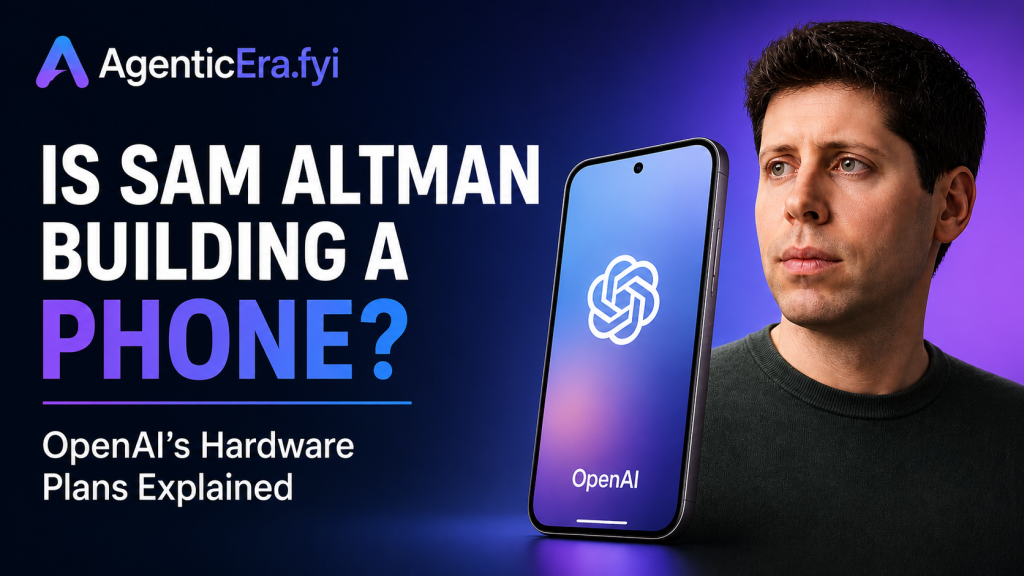
Sam Altman, the CEO of OpenAI, is making a bold move beyond software — and it could change the way we interact with technology forever. From a secretive AI wearable designed by the man who gave us the iPhone, to reports of a full-blown smartphone rival, OpenAI’s hardware ambitions are one of the biggest stories in tech right now. Here’s a complete, up-to-date breakdown of everything we know.
The Big Picture: OpenAI Is Going Into Hardware
For years, OpenAI was purely a software and AI research company — the team behind ChatGPT, DALL·E, and some of the world’s most powerful AI models. But that’s changing rapidly. In May 2025, OpenAI made one of its most significant moves yet: it acquired io Products, a hardware startup co-founded by legendary Apple designer Jony Ive, for approximately $6.4–6.5 billion in an all-stock deal.
Jony Ive is the designer responsible for the original iPhone, iPod, iMac, and iPad — arguably the most influential industrial designer of the past 30 years. His involvement signals that OpenAI isn’t just dabbling in hardware; it’s swinging for the fences.
Under the partnership, Altman continues as OpenAI’s CEO while Ive takes on “deep creative and design responsibilities across OpenAI and io,” with his independent design firm LoveFrom remaining a separate entity.
What Is OpenAI Actually Building?
There are currently two distinct hardware projects being reported — and it’s important not to confuse them.
1. The AI Wearable (The “First Device”)
This is the confirmed, officially acknowledged product. OpenAI’s Chief Global Affairs Officer Chris Lehane confirmed at the World Economic Forum in Davos that the company is “on track” to unveil its first consumer hardware device in the second half of 2026, calling it one of the “big coming attractions” for OpenAI this year.
Based on leaks and reports, the device is described as:
- Pocket-sized and completely screenless — no display whatsoever
- Voice-first, with AI interaction through speech rather than touch
- Always-on and contextually aware, using built-in cameras and microphones to understand your surroundings
- Potentially a pill-shaped, behind-the-ear wearable codenamed “Sweetpea”, powered by a custom 2nm chip with dual-NPU architecture
- Designed to be a “peaceful” alternative to the smartphone — Altman himself has described it this way
Sam Altman reportedly told OpenAI staff after testing Jony Ive’s prototype at home that it is “the coolest piece of technology that the world will have ever seen.” He also said in November 2025: “Finally, we have the first prototypes. I can’t believe how jaw dropping good the work is.”
A second codename — “Gumdrop” — has also leaked, suggesting the possibility of a pen-style device in the pipeline.
Timeline update: While the original goal was to ship in 2026, court documents filed in a trademark dispute with audio startup iYo revealed that OpenAI does not expect to ship its first hardware product before the end of February 2027. The same filing confirmed OpenAI has also abandoned the “io” branding for the product due to the ongoing legal dispute.
2. The OpenAI Smartphone (The “Phone Rival”)
This is the project that’s captured the most headlines — and the most excitement. In late April 2026, Apple supply chain analyst Ming-Chi Kuo reported that OpenAI is developing a full smartphone designed to directly compete with the iPhone.
Key details from Kuo’s supply chain research:
- Chip partners: Qualcomm and MediaTek are co-developing a custom AI-native processor, likely a customized Dimensity 9600 built on TSMC’s N2P node
- Manufacturing partner: Luxshare Precision Industry (which also assembles AirPods and a growing share of iPhones for Apple)
- Specifications finalized: Expected by late 2026 or Q1 2027
- Mass production target: 2028
- Interface: Instead of a traditional app grid, the phone would use a real-time “task stream” driven entirely by AI agents
Important caveat: There is currently no confirmed release date, retail price, or official announcement from OpenAI specifically regarding the smartphone. None of the named supply chain partners have publicly confirmed their involvement.
What Did Sam Altman Actually Say?
Altman has been characteristically cagey about the specifics, but he has dropped several public hints.
On the same day Kuo published his findings about the OpenAI phone, Altman posted on X (formerly Twitter): “feels like a good time to seriously rethink how operating systems and user interfaces are designed (also the internet).” The timing was widely interpreted as deliberate.
On the broader hardware vision, Altman has spoken more openly. He has described the goal as moving away from “dumb reactive” computers toward “very smart proactive” ones. He’s critiqued the keyboard as “a keyboard that was built to slow down how fast you could get information into it” — a design assumption from decades ago that he says is “unquestioned” but may be wrong for the AI era.
He has also described the upcoming wearable as a “third device” — not meant to replace your phone or laptop, but to complement them with something entirely new.
How Is This Different From Your Current Smartphone?
The distinction OpenAI is drawing is significant. Today’s smartphones are app-based: you open an app to do a task. OpenAI’s vision — for both the wearable and the reported phone — is agent-based: you tell the AI what you want, and it does it across whatever services or tools are needed, without you ever touching an app.
The reported phone would replace the conventional home screen with a real-time “task stream” showing what AI agents are currently doing on your behalf — tracking a flight, setting an appointment, drafting a message. The AI acts as a continuous co-pilot, using your location, activity, and communication history to proactively take action.
This would be a fundamental shift — not just a new device, but a new model of how humans and computers interact.
The Jony Ive Factor
It’s impossible to overstate how significant Jony Ive’s involvement is. Ive’s design philosophy — minimalism, restraint, intentionality — shaped an entire generation of consumer technology. His acquisition into OpenAI for $6.4 billion brought 55 employees in-house, including hardware veterans Scott Cannon, Evans Hankey, and Tang Tan.
Interestingly, Ive has publicly expressed reluctance to revisit the smartphone form factor, reportedly wanting to use his next chapter in hardware to undo some of the societal harm smartphones have caused — the addiction, the distraction, the erosion of real-world presence. His involvement in any OpenAI phone project would therefore carry a philosophical dimension beyond pure engineering.
What Are the Challenges?
OpenAI faces significant hurdles on the road to becoming a hardware company:
- Legal issues: A trademark dispute with audio startup iYo has already forced a rebrand and pushed the first device’s launch into 2027.
- Competition: Apple, Google (Pixel), and Samsung are all aggressively integrating AI into their devices. Differentiation will be hard to maintain if the major players catch up on agentic AI.
- Trust and privacy: An always-on, always-listening device from a company like OpenAI raises serious privacy questions that will need transparent answers.
- Distribution: Apple controls one of the most powerful retail and online distribution networks in consumer electronics — a network OpenAI will need to build from scratch.
- Form factor risk: Previous AI gadgets, like the Humane AI Pin, were largely commercial failures. OpenAI will need to convince consumers this is genuinely different.
Timeline at a Glance
| Milestone | Date |
|---|---|
| OpenAI acquires Jony Ive’s io Products | May 2025 |
| First prototypes confirmed by Altman | November 2025 |
| OpenAI confirms H2 2026 hardware reveal (Lehane at Davos) | January 2026 |
| Court filings push first device ship date to Feb 2027+ | February 2026 |
| Ming-Chi Kuo reports OpenAI smartphone project | April 2026 |
| Reports of phone being fast-tracked | May 2026 |
| Specs & suppliers finalized (phone) | Late 2026 / Q1 2027 (est.) |
| First wearable device ships | Early 2027 (est.) |
| Phone mass production | 2027–2028 (est.) |
Bottom Line
Sam Altman and OpenAI are making a serious, well-resourced push into consumer hardware — and it’s bigger than just a phone. The first product on the horizon is a screenless, voice-first AI wearable co-designed with Jony Ive, likely arriving in early 2027. Behind that, credible supply chain reports point to a full AI-agent smartphone that could rival the iPhone — potentially launching in 2027 or entering mass production in 2028.
Whether OpenAI can pull this off remains to be seen. But with Jony Ive’s design genius, massive financial backing, and the world’s most capable AI models under the hood, this is the most credible challenge to Apple’s hardware dominance since Android launched in 2008.
Watch this space.