What Is Hermes Agent?
Hermes Agent is an open-source, autonomous AI agent built by Nous Research — the team behind the Hermes, Nomos, and Psyche model families. Released in February 2026, it quickly became one of the fastest-growing open-source projects in AI history, surpassing 100,000 GitHub stars in record time.
Unlike traditional coding copilots tethered to an IDE or simple chatbot wrappers around a single API, Hermes Agent is something fundamentally different: a persistent, self-hosted AI agent that lives on your server, remembers everything it learns across sessions, and becomes measurably more capable the longer it runs.
In short: it’s the AI agent that actually grows with you.
The Problem Hermes Agent Solves
Every AI agent user knows the frustration. You teach your agent something on Monday — your project structure, your preferences, your workflow — and by Tuesday, it has forgotten everything. You’re back to square one, re-explaining context like you’re training a new intern every single morning.
Most AI tools ship a vector database, call it “long-term memory,” and move on. Hermes Agent takes a fundamentally different approach with a closed learning loop that compounds in value over time instead of resetting to zero at the start of every session.
Key Features of Hermes Agent
1. Persistent Cross-Session Memory
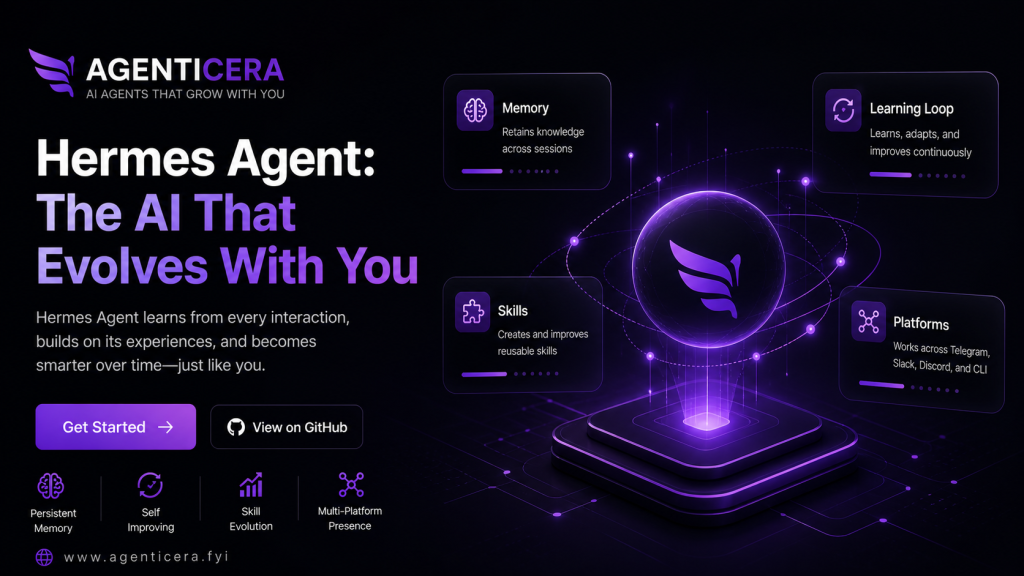
Hermes Agent remembers your projects, preferences, and context — indefinitely. Using FTS5 full-text search with LLM summarization, the agent can recall information from past conversations across sessions. You never have to re-explain your codebase, workflow, or environment again.
2. Autonomous Skill Creation and Self-Improvement
When Hermes solves a hard problem, it writes a reusable skill document so it never forgets how. These skills are autonomously created from experience, improved during use, and reused across future sessions. Skills are searchable, shareable, and compatible with the agentskills.io open standard, enabling a growing community skill hub.
3. Model-Agnostic Runtime
Hermes Agent is not locked to a single AI provider. You can use it with Nous Portal, OpenRouter (200+ models), NVIDIA NIM, OpenAI, or your own custom endpoint. Switching models requires a single command (hermes model) — no code changes, no migration headaches.
4. Multi-Platform Messaging
Hermes Agent meets you where you are. It supports 15+ communication platforms from a single gateway process, including:
- Telegram
- Discord
- Slack
- Signal
- Matrix
- SMS
- Home Assistant
- CLI
Start a task on Telegram and pick it up on Slack. The agent is always reachable.
5. Flexible Deployment — Runs Anywhere
Hermes is not tied to your laptop. It supports 6 terminal backends:
- Local — run it on your own machine
- Docker — containerized with namespace isolation
- SSH — pin it inside a customer’s VPC
- Daytona — serverless with persistent state
- Singularity — HPC-grade environments
- Modal — serverless; hibernates when idle, costs nearly nothing between sessions
You can run a powerful persistent AI agent on a $5 VPS or scale it to a GPU cluster — all with the same codebase.
6. 40+ Built-In Tools
Out of the box, Hermes Agent ships with over 40 tools, including:
- Web search and content extraction
- Browser automation and vision
- Image generation
- Text-to-speech (TTS)
- Scheduled automations (natural language cron)
- MCP (Model Context Protocol) support for extended tool capabilities
- Isolated subagents for zero-context-cost pipelines
7. Privacy-First by Design
All data stays on your machine. There is no telemetry, no tracking, and no cloud lock-in. Hermes Agent is fully MIT-licensed and open source, making it a trustworthy choice for individuals and enterprises that take data privacy seriously.
How Hermes Agent’s Learning Loop Works
The core innovation behind Hermes Agent is its closed learning loop, which operates through four interconnected mechanisms:
- Agent-curated memory — The agent stores important context and preferences autonomously, with periodic nudges to persist valuable knowledge.
- Skill creation from experience — After completing complex tasks, Hermes writes procedural skill documents so it can replicate and refine those solutions in the future.
- Cross-session recall — FTS5-powered search combined with LLM summarization lets Hermes surface relevant past conversations and context at any time.
- Honcho dialectic user modeling — The agent builds a deepening model of who you are across sessions, tailoring its responses and behavior to your unique workflow over time.
This means the longer you use Hermes Agent, the more valuable it becomes — a compounding AI investment rather than a disposable tool.
Hermes Agent vs. OpenClaw
Since its launch, Hermes Agent has been widely compared to OpenClaw, the previously dominant open-source agent framework. The key differences come down to design philosophy:
| Feature | Hermes Agent | OpenClaw |
|---|---|---|
| Memory model | Self-curated, layered stack | File-backed, explicit |
| Skill creation | Autonomous | Human-authored |
| Control style | Agent-driven, safer-by-default | Tighter manual control |
| Session history | SQLite + FTS5 full-text search | Traditional logs |
| User modeling | Honcho dialectic modeling | SOUL.md identity file |
Hermes excels when you want a long-running agent that compounds through use. OpenClaw shines when you prefer tighter manual control and a workspace-native assistant model. Hermes Agent even supports automatic migration from OpenClaw via hermes claw migrate, making it easy to switch.
Who Is Hermes Agent Built For?
Hermes Agent is designed for a wide range of users:
- Developers who want an autonomous coding and automation agent that learns their codebase over time.
- Researchers who need batch trajectory generation, RL training environments, and Atropos integration for fine-tuning models.
- Entrepreneurs and content creators who want to automate recurring tasks, reports, and workflows across multiple platforms.
- Teams who want Slack or Discord-based AI assistance with MCP integration for extended tooling.
- Privacy-conscious users who want a powerful AI agent running entirely on their own infrastructure.
How to Get Started with Hermes Agent
Getting started is remarkably simple. Hermes Agent works on Linux, macOS, and WSL2, and the installer handles all platform-specific setup automatically.
Step 1 — Install with one command:
curl -fsSL https://raw.githubusercontent.com/NousResearch/hermes-agent/main/scripts/install.sh | bashStep 2 — Run the setup wizard:
hermes setupStep 3 — Set your model provider (Nous Portal, OpenRouter, OpenAI, or a custom endpoint) and connect your messaging platform.
Step 4 — Start your first conversation. Hermes Agent begins learning immediately — building memory, creating skills, and getting smarter with every session.
Android users: Hermes Agent can also be run via Termux with a documented manual installation path.
Research and Enterprise Use Cases
Beyond personal productivity, Hermes Agent is built for AI research and enterprise automation:
- Batch trajectory generation for training data at scale
- Atropos RL integration for reinforcement learning on agent behaviors
- Trajectory compression for training the next generation of tool-calling models
- MCP server connectivity for extending capabilities to any enterprise tool
- Context files that shape every conversation to a specific project’s requirements
An enterprise fork with signed skills, audit logs, and role-based approval is widely anticipated as adoption continues to grow.
Why Hermes Agent Matters for the Future of AI
Hermes Agent represents a major shift in how we think about AI assistants. The dominant paradigm — stateless chatbots that reset with every session — is being replaced by something far more powerful: persistent agents that compound in intelligence over time.
With over 100,000 GitHub stars, five major releases in its first 20 days, and a rapidly growing community of contributors and skill builders, Hermes Agent is more than a trending project. It’s a glimpse at what the next generation of personal AI will look like — always on, always learning, and always yours.
Final Thoughts
If you’ve been frustrated by AI tools that forget everything overnight, Hermes Agent is built for you. It’s open source, private by default, model-agnostic, and capable of running on infrastructure as modest as a $5 VPS. Whether you’re a solo developer, a researcher, or an enterprise team, Hermes Agent offers a practical, powerful path toward AI that genuinely grows with you.
Get started today: hermes-agent.nousresearch.com | GitHub
Tags: Hermes Agent, Nous Research, open-source AI agent, self-improving AI, persistent AI agent, AI automation, autonomous agent, AI memory, multi-platform AI, Hermes vs OpenClaw