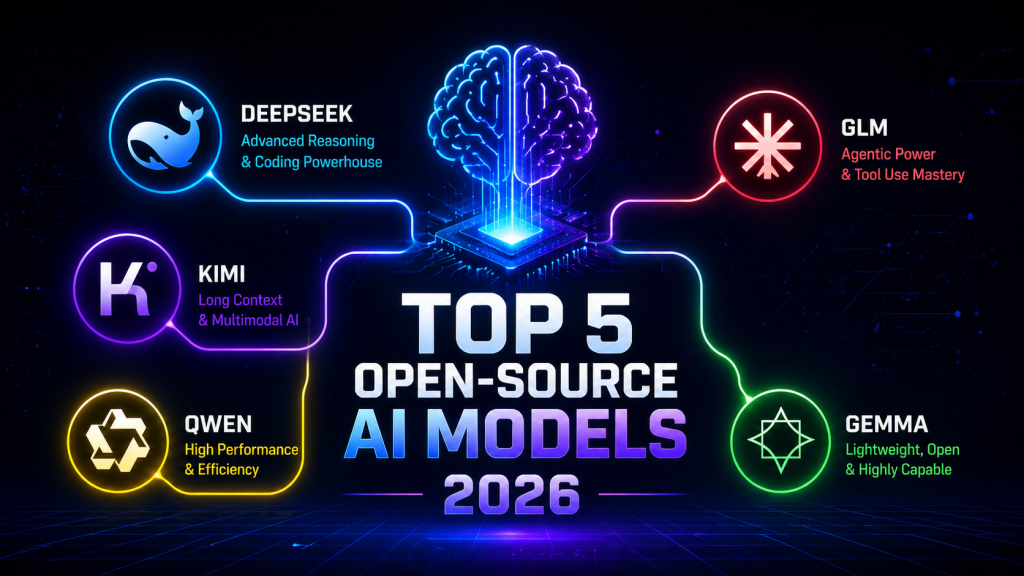
The walls around frontier AI are crumbling. Open-source models aren’t just catching up — in some areas, they’ve already taken the lead.
Not long ago, building with serious AI meant one thing: a proprietary API, a growing monthly bill, and a quiet acceptance of vendor lock-in. That era is ending. In 2026, open-weight large language models are no longer the scrappy underdogs of the AI world. They are production-ready, enterprise-deployable, and increasingly indistinguishable from their closed-source counterparts — in the benchmarks that matter and the workflows that count.
For developers, researchers, and AI-first teams, the implications are huge. Self-hosting means full data sovereignty. Fine-tuning on your own data means models that actually understand your domain. And no token limits means your agentic pipelines run as long as they need to.
Here are the five open-source AI models that are defining the landscape right now.
1. 🦙 Meta Llama 4 — The Community Standard
Developer: Meta AI License: Llama Community License Best For: General-purpose tasks, RAG pipelines, customer service automation
If open-source AI has a flagship, it’s Llama. Meta’s Llama 4 remains the most widely deployed open-weight model in the world, powering everything from enterprise knowledge bases to customer support bots. Its Scout variant has become the go-to choice for retrieval-augmented generation (RAG) workflows — particularly in industries like legal, finance, and healthcare where processing dense, unstructured documents is a daily requirement.
But what makes Llama 4 so enduring isn’t just performance — it’s the ecosystem. A vast library of fine-tuned derivatives, community quantizations, and battle-tested deployment tooling means you’re rarely building from scratch. Spin it up locally with Ollama in a single command, or scale it to thousands of concurrent users with vLLM. The infrastructure story is mature, the documentation is rich, and the community is enormous.
For teams just entering the open-source AI space, Llama 4 remains the safest, most practical starting point.
✅ Why it matters for agentic workflows: Extensive tool-use support and a rich ecosystem of agent frameworks (LangChain, LlamaIndex, CrewAI) make Llama 4 one of the most battle-tested foundations for building AI agents.
2. 🧠 DeepSeek R1 / DeepSeek V4 — The Reasoning Powerhouse
Developer: DeepSeek License: MIT Best For: Chain-of-thought reasoning, cost-efficient self-hosting, air-gapped deployments
DeepSeek didn’t just release a model — it sent a message. When R1 dropped in early 2025, it proved definitively that open-weight models could deliver frontier-level reasoning without a frontier-level price tag. Its 671B Mixture-of-Experts architecture keeps only ~37B parameters active per token, making inference far more efficient than the raw parameter count implies.
The follow-up, DeepSeek V4, has since become the benchmark for self-hosted deployments where the performance-to-cost ratio is everything. Its MIT license is one of the most permissive in the space — no usage caps, no display requirements, no revenue thresholds. For regulated industries, sovereign AI initiatives, or any use case where data simply cannot leave your infrastructure, DeepSeek is a compelling alternative that closed-source APIs structurally cannot offer.
✅ Why it matters for agentic workflows: DeepSeek’s chain-of-thought specialization gives it an edge in multi-step reasoning tasks — exactly the kind of deliberate, structured thinking that autonomous agents need to avoid compounding errors over long task horizons.
3. 🌐 Qwen 3.5 — The Global Powerhouse
Developer: Alibaba Cloud License: Apache 2.0 Best For: Multilingual apps, mathematics, coding, long-context reasoning
Qwen 3.5 may be the most technically audacious open-source release of 2026. Released in February, this native vision-language model packs 397 billion total parameters into a Mixture-of-Experts design that activates only ~17B parameters per forward pass. The result: massive model capacity at a fraction of the expected inference cost.
Its 1 million token context window is one of the longest available in any open-weight model today — purpose-built for tasks requiring deep, sustained reasoning over enormous amounts of text. And with support for over 201 languages, it’s the dominant choice for globally-facing products, particularly in multilingual and Asian markets.
The instruction-tuned Qwen 3.6 Plus variant has earned recognition as the top open-weight model for demanding agentic coding, posting benchmark scores that rival closed-source frontier systems.
✅ Why it matters for agentic workflows: A 1M token context window is a game-changer for agents that need to reason over entire codebases, lengthy research threads, or multi-session conversation histories without losing context.
4. 💎 Google Gemma 4 — Frontier Intelligence, Laptop-Sized
Developer: Google DeepMind License: Apache 2.0 Best For: On-device deployment, privacy-first applications, multimodal tasks
Google’s Gemma 4 answers a question the AI industry has been asking for years: how much can you compress frontier intelligence before quality breaks down? The 31B dense variant is the clearest answer yet — delivering reasoning and coding performance that competes with models several times its size, while running comfortably on a single 80GB H100. Its hybrid attention mechanism keeps memory usage efficient even across its 256K token context window.
The E4B (8B) variant is where things get genuinely exciting for the AgenticEra audience. Fully multimodal — handling text, images, and audio — it supports tool calling and code execution while fitting on consumer hardware. For developers building privacy-first AI assistants that can see, hear, and act without ever sending data to a cloud API, Gemma 4 E4B is currently the best option on the open-source market. Apache 2.0 licensing means zero commercial headaches.
✅ Why it matters for agentic workflows: On-device, multimodal, tool-use capable, and Apache 2.0 licensed — Gemma 4 is uniquely positioned for edge-deployed agents that need to perceive and act in the real world without a network dependency.
5. 🚀 Kimi K2.6 — Built for Agents
Developer: Moonshot AI License: Modified MIT Best For: Autonomous agents, agentic coding, sub-agent parallelism, UI generation
If any model on this list was built with the agentic era explicitly in mind, it’s Kimi K2.6. This is Moonshot AI’s engineering statement: a 1 trillion parameter MoE model with 32B active parameters per token, 384 experts, and what the company calls an “Agent Swarm” architecture — purpose-designed for persistent, parallel, multi-agent workflows.
The numbers back up the ambition. Internal tests showed a Kimi K2.6-backed agent running autonomously for five consecutive days — managing monitoring, incident response, and system operations without a single human check-in. It excels at multi-file code editing, tool-driven planning, and can even translate a simple text prompt into a polished front-end UI complete with animations and interactive elements.
Its cost-efficient sub-agent architecture is the other headline: you can run dozens of parallel Kimi instances across a codebase simultaneously without the inference bill becoming the constraint. For teams building real autonomous engineering pipelines, that matters enormously.
✅ Why it matters for agentic workflows: Kimi K2.6 isn’t adapted for agents — it was designed for them. The Agent Swarm architecture, long-context stability, and proven multi-day autonomy make it the most credible open-source foundation for ambitious autonomous AI systems today.
At a Glance
| Model | Developer | Best For | Context | License |
|---|---|---|---|---|
| Llama 4 | Meta | General use, RAG | Varies | Llama License |
| DeepSeek R1/V4 | DeepSeek | Reasoning, self-hosting | 128K | MIT |
| Qwen 3.5 | Alibaba | Multilingual, agentic coding | 1M tokens | Apache 2.0 |
| Gemma 4 | Google DeepMind | On-device, privacy | 256K | Apache 2.0 |
| Kimi K2.6 | Moonshot AI | Autonomous agents | 256K | Modified MIT |
The Takeaway
The open-source LLM ecosystem in 2026 has matured past the point where proprietary APIs are the obvious default. You now have access to models with million-token context windows, native multimodal capabilities, and proven autonomous task execution — all deployable on your own infrastructure, fine-tunable on your own data, and free from per-token pricing anxiety.
The question is no longer open-source or closed-source. It’s which open model for which task.
Pick your use case. Run your evals. Build the agent pipeline you’ve been imagining.
Want to go deeper? Subscribe to AgenticEra for weekly breakdowns of the models, tools, and frameworks shaping the autonomous AI era.